Who am I?
- I am a daughter of Heavenly Father, who knows me and loves me.
- I have been made a little lower than the angels and to be crowned with glory and honour. I can have dominion over the works of my hands; all things have been put under my feet. (Psalm 8:4-6)
- Before I was created physically on earth, God knew me; and before I was born, I was set apart and made holy. (Jeremiah 1:5)
- Before I was born I stood with many noble and great spirits.I was chosen then to be a leader on earth. (Abraham 3:22-23)
- I am of infinite worth with my own divine mission, which I will strive to fulfill.
- Heavenly Father also wants me to remember that the worth of souls is great in the sight of God(D&C 18:10) and the first great commandment is to love others as I love myself. (John 13:34-35)
- Heavenly Father is mindful of me and of everyone else too.
And what of that? Why does that matter? What is the point? What is it that I can do in my life? And why am I writing this?
Well because what is more important than knowing that I am a daughter of God and that He wants me to love myself and others. Probably nothing, but also noteworthy is that I am teaching this lesson to 12 and 13 year olds on Sunday and thought that I might as well record my thoughts for posterity on the internet.
So because I know that I am a literal spirit daughter of Heavenly Father, then what?
Well here is a scripture story told by Elder Jeffrey R. Holland in October 2012 which perhaps answers that question:
There is almost no group in history for whom I have more sympathy than I have for the eleven remaining Apostles immediately following the death of the Savior of the world. I think we sometimes forget just how inexperienced they still were and how totally dependent upon Jesus they had of necessity been. To them He had said, "Have I been so long time with you, and yet hast thou not known me … ?" (John 14:9)
But, of course, to them He hadn’t been with them nearly long enough. Three years isn’t long to call an entire Quorum of Twelve Apostles from a handful of new converts, purge from them the error of old ways, teach them the wonders of the gospel of Jesus Christ, and then leave them to carry on the work until they too were killed. Quite a staggering prospect for a group of newly ordained elders.
Then, after such a short time to learn and even less time to prepare, the unthinkable happened, the unbelievable was true. Their Lord and Master, their Counselor and King, was crucified. His mortal ministry was over, and the struggling little Church He had established seemed doomed to scorn and destined for extinction. His Apostles did witness Him in His resurrected state, but that only added to their bewilderment. As they surely must have wondered, "What do we do now?" they turned for an answer to Peter, the senior Apostle.
Here I ask your indulgence as I take some nonscriptural liberty in my portrayal of this exchange. In effect, Peter said to his associates: "Brethren, it has been a glorious three years. None of us could have imagined such a few short months ago the miracles we have seen and the divinity we have enjoyed. We have talked with, prayed with, and labored with the very Son of God Himself. We have walked with Him and wept with Him, and on the night of that horrible ending, no one wept more bitterly than I. But that is over. He has finished His work, and He has risen from the tomb. He has worked out His salvation and ours. So you ask, ‘What do we do now?’ I don’t know more to tell you than to return to your former life, rejoicing. I intend to ‘go a fishing.’” And at least six of the ten other remaining Apostles said in agreement, “We also go with thee.” John, who was one of them, writes, “They went forth, and entered into a ship immediately.” (John 21:3)
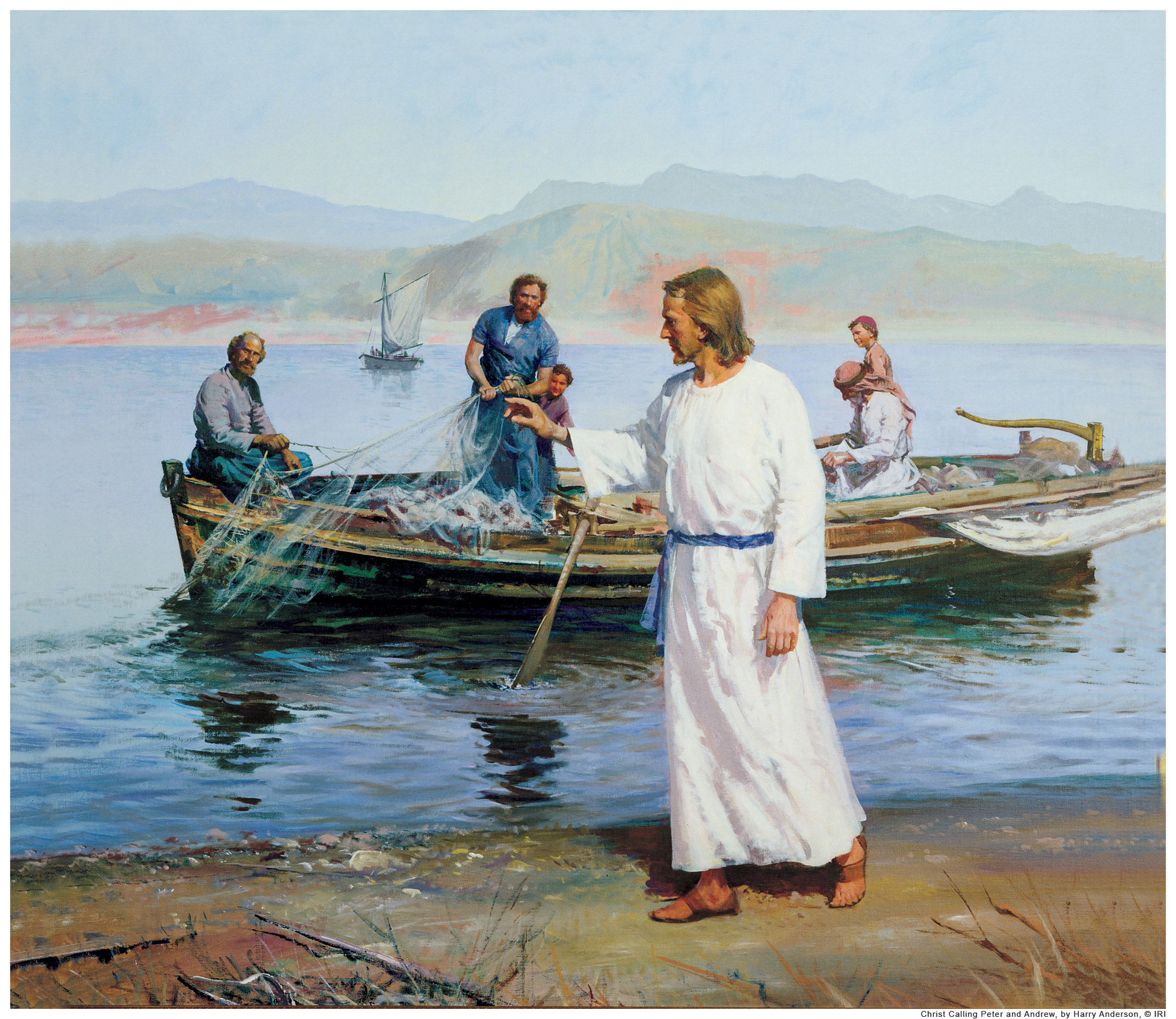
But, alas, the fishing wasn’t very good. Their first night back on the lake, they caught nothing—not a single fish. With the first rays of dawn, they disappointedly turned toward the shore, where they saw in the distance a figure who called out to them, “Children, have you caught anything?” Glumly these Apostles-turned-again-fishermen gave the answer no fisherman wants to give. “We have caught nothing,” they muttered, and to add insult to injury, they were being called “children.”
“Cast the net on the right side of the ship, and ye shall find,” the stranger calls out—and with those simple words, recognition begins to flood over them. Just three years earlier these very men had been fishing on this very sea. On that occasion too they had “toiled all the night, and [had] taken nothing,” the scripture says. But a fellow Galilean on the shore had called out to them to let down their nets, and they drew “a great multitude of fishes,” enough that their nets broke, the catch filling two boats so heavily they had begun to sink.
Now it was happening again. These “children,” as they were rightly called, eagerly lowered their net, and “they were not able to draw it for the multitude of fishes.” John said the obvious: “It is the Lord.” And over the edge of the boat, the irrepressible Peter leaped.
After a joyful reunion with the resurrected Jesus, Peter had an exchange with the Savior that I consider the crucial turning point of the apostolic ministry generally and certainly for Peter personally, moving this great rock of a man to a majestic life of devoted service and leadership. Looking at their battered little boats, their frayed nets, and a stunning pile of 153 fish, Jesus said to His senior Apostle, “Peter, do you love me more than you love all this?” Peter said, “Yea, Lord; thou knowest that I love thee.”
The Savior responds to that reply but continues to look into the eyes of His disciple and says again, “Peter, do you love me?” Undoubtedly confused a bit by the repetition of the question, the great fisherman answers a second time, “Yea, Lord; thou knowest that I love thee.”
The Savior again gives a brief response, but with relentless scrutiny He asks for the third time, “Peter, do you love me?” By now surely Peter is feeling truly uncomfortable. Perhaps there is in his heart the memory of only a few days earlier when he had been asked another question three times and he had answered equally emphatically—but in the negative. Or perhaps he began to wonder if he misunderstood the Master Teacher’s question. Or perhaps he was searching his heart, seeking honest confirmation of the answer he had given so readily, almost automatically. Whatever his feelings, Peter said for the third time, “Lord, … thou knowest that I love thee.”
To which Jesus responded (and here again I acknowledge my nonscriptural elaboration), perhaps saying something like: “Then Peter, why are you here? Why are we back on this same shore, by these same nets, having this same conversation? Wasn’t it obvious then and isn’t it obvious now that if I want fish, I can get fish? What I need, Peter, are disciples—and I need them forever. I need someone to feed my sheep and save my lambs. I need someone to preach my gospel and defend my faith. I need someone who loves me, truly, truly loves me, and loves what our Father in Heaven has commissioned me to do. Ours is not a feeble message. It is not a fleeting task. It is not hapless; it is not hopeless; it is not to be consigned to the ash heap of history. It is the work of Almighty God, and it is to change the world. So, Peter, for the second and presumably the last time, I am asking you to leave all this and to go teach and testify, labor and serve loyally until the day in which they will do to you exactly what they did to me.”
Here I will end Elder Holland’s talk for a moment and insert a thought that came to me as I read John chapter 21 a few weeks ago with the thoughts “Who am I?” and “What Can I Become?” and perhaps mostly importantly “What do these young women (and I) need to learn about this?”
I think we all need to learn that we are loved immensely by God and that in turn He wants us to learn to love Him and His Son. I also think we need to learn that God sent each of us to earth as individual beings. He did not send us to do nothing. He did not send us to do only what we want to do. He sent us to learn to trust Him and choose, like Peter, to do His will.
We are like seeds, and like seeds are embryos of the plant they can become, we are embryos of the gods we can become. Just like little seeds which grow into large and fruitful plants, we have an opportunity to grow and produce beautiful and useful things on earth. And like seeds, we children of God, are very much the same and yet very different.
Bean seeds have a very different size shape and destiny from carrot and lettuce seeds. Each seed has the potential to sprout, grow, bloom and become what it was destined to become.
Embryos of God too are so much alike, yet with so much difference in the end product. We all have hands. Those hands are made up of bone, blood, and sinew. All of them. But the things those hands can do and the things that they were created to do are as varied as the people who they are attached to.
I possess within myself parts of DNA that come from each of my parents and also my grandparents, but I am not them. I possess similiar DNA to my sisters, but I am not them. I am myself. I am an individual being, and I am capable of many things. And I have many options open before me to chose from learning and doing.
Yet just because I can do something doesn’t mean that is what God needs or wants me to do. He has a plan for me and a plan for everyone around me too. And just like with Peter, He lets each of us choose whether to follow Him or not.
And He doesn't setup our value by the same standards that the world does. God said that each soul is precious and of great worth to Him. When we begin to judge ourselves against the accomplishments of others, we are listening to the whisperings (well often it is more like full on, slap you in the face, screaming...) of the world.
Embryos of God too are so much alike, yet with so much difference in the end product. We all have hands. Those hands are made up of bone, blood, and sinew. All of them. But the things those hands can do and the things that they were created to do are as varied as the people who they are attached to.
I possess within myself parts of DNA that come from each of my parents and also my grandparents, but I am not them. I possess similiar DNA to my sisters, but I am not them. I am myself. I am an individual being, and I am capable of many things. And I have many options open before me to chose from learning and doing.
Yet just because I can do something doesn’t mean that is what God needs or wants me to do. He has a plan for me and a plan for everyone around me too. And just like with Peter, He lets each of us choose whether to follow Him or not.
And He doesn't setup our value by the same standards that the world does. God said that each soul is precious and of great worth to Him. When we begin to judge ourselves against the accomplishments of others, we are listening to the whisperings (well often it is more like full on, slap you in the face, screaming...) of the world.
Elder Holland ends his narration of the story in John chapter 21 a verse before this question from Peter to the Savior:
“Then Peter, turning about, seeth the disciple whom Jesus loved, [John], following; [John] which also leaned on his [the Savior’s] breast at supper…
Peter seeing [John] saith to Jesus, 'Lord, what shall this man do?’
Jesus saith unto him, ‘If I will that he tarry till I come, what is that to thee?[Peter], follow thou me.’” (John 21:20-22)
Now, I have to admit, I think John the Beloved is amazing and awesome. But I also find him irritating. John's book tell of how he was the favorite of the Savior. Of how he outran the others when he went to the empty tomb, indicating that either he loved the Savior more, was a fabulous runner, or both. And with my eyes and mind nutured in the present world culture hell bent on ranking everyone by level of accomplishment, fame, and fortune, I see John as having a better place than me in the sight of God. Perhaps that is what Peter felt too.
But the beauty of the plan of the Father, is that my worth is not measured at all against what some one else does. In fact my worth is not based even on what I do. My worth is infinite and eternal. I am a Child of God. A Savior and Redeemer came and assured my worth and my continuation on as a immortal soul.
My eternal reward does have something to do with my choices here on earth however. I have got to try. I have got to try to follow Christ. I have got to try my best to listen to the whisperings of the Spirit and not the screaming of the world. I have got to do my best to accomplish what I need to do, and then the Savior will step in and lift me the rest of the way. Just like He will lift Peter and John and everyone else who will allow Him to lift them.
So, who am I?
I am a daughter of God with infinite worth, infinite potential. And I will follow His plan for me.
But the beauty of the plan of the Father, is that my worth is not measured at all against what some one else does. In fact my worth is not based even on what I do. My worth is infinite and eternal. I am a Child of God. A Savior and Redeemer came and assured my worth and my continuation on as a immortal soul.
My eternal reward does have something to do with my choices here on earth however. I have got to try. I have got to try to follow Christ. I have got to try my best to listen to the whisperings of the Spirit and not the screaming of the world. I have got to do my best to accomplish what I need to do, and then the Savior will step in and lift me the rest of the way. Just like He will lift Peter and John and everyone else who will allow Him to lift them.
So, who am I?
I am a daughter of God with infinite worth, infinite potential. And I will follow His plan for me.