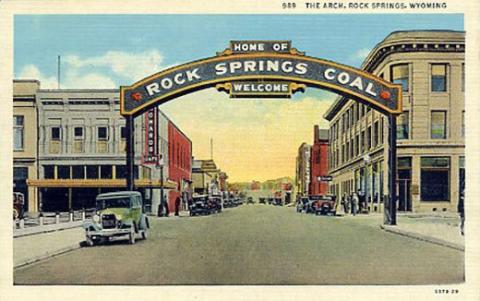
The Rock Springs, Wyoming economy seemed (and still seems) to be in a continual boom/bust cycle. The major careers in the area revolved and still revolve around resource extraction, also known as coal and trona mining. (Oil and natural gas extraction caused another boom starting in about 2000, after I was gone.)
The Blair brothers opened the first coal mine in Rock Springs in 1868 just before the arrival of the Union Pacific Railroad line. At one point Rock Springs and the surrounding Sweetwater County hosted 130 operating mines.
Coal mining fueled the railroads and the local economy, but took a hit in the 1890 depression. But mining rallied again in 1920, allowing men to make a larger wage of $8/ day in the mines bringing out coal. According to a Wyoming history essay $8 was the equivalent of $91/day in 2012. The Great Depression hit the area again, but due to neighbors helping neighbors, many weathered that storm and came out the other side.
Of course, Rock Springs was not always a neighborly place to live. For a rather small and desolate place, Rock Springs attracted all types of people. Robert Leroy Parker aka Butch Cassidy worked on several of the ranches that surround the town and he spent a brief time as a butcher in town, hence the nickname Butch. He left without causing problems in the little town.
Yet Butch was just a small note in the 1880 history of the town. The big news, that I was even taught in fourth grade, involved the Chinese Massacre. For a town that often seemed to embody cultural diversity, the Massacre was a huge black spot.
It happened on September 2, 1885. White miners attacked the Chinese miners who had been brought in by the railroad to help work the mines. When the conflict ended, twenty-eight Chinese were dead, fifteen were wounded, and hundreds more had fled the town. Most of the whites who caused the problem left soon after. And fortunately not all the Chinese fled, because Rock Springs boasted some of the best Chinese food anywhere thanks to their descendants a hundred years later.
In the 1950's when trains switched to diesel and cars took over the roads, the coal industry took a huge hit, but at that same time the largest known deposit of trona was discovered. Out of work coal miners easily switched over to working in the trona mines east of Green River.
And again because of coal the Rock Springs economy boomed when in the 1970's, workers flooded into the area to build the billion dollar Jim Bridger Power Plant which still supplies coal fired power (electricity) to parts of the northwest, including the Idaho house where I currently live.
The climate was tough. The jobs were hard. And the people were rough.
Money flowed out of the mines. Much of it into the pockets of people who ran the railroad, but because coal was vital to the rail industry, large amounts also went back to the workers. Many of the people of Rock Springs came as immigrants from Europe and Asia to work in the mines. Many had money because they were miners. Others provided services to miners. Some services legal (food, housing, education). Some not so (prostitution and drugs).
The town was in a perpetual boom/bust cycle, and so were the people.
Like I said, the people were rough. But mostly they were good. Many believed in God. Many went to church. Rock Springs had many denominations: Catholic, Greek Orthodox, Episcopal, Christian Science, Seventh Day Adventist, Lutheran, Methodist, Presbyterian, Latter-day Saints, Baptists Free Evangelical, Congregational, and Jehovah Witness.
A history of the Catholic Church in Rock Springs
written by one of my high school English teachers,
Some went to church every Sunday. Some went for Christmas and Easter. Some just claimed a religion but never really went. Some didn't claim anything and ridiculed the those who did. And probably that is what made all of them who they were. Because, despite the ever popular belief that God doesn't matter, people have to have something to hold on to. They have to root themselves in some kind of bedrock. Center themselves firmly with faith in something. Otherwise the whims of the world and that continually blasting wind will blow you away.It took me years to come to an understanding of what exactly helped me get through my teens, in that place, with some people who were quite good, some who were quite confused, and some who were just plain evil. (I say this with the authority of a girl who went to school with multiple murders. Some were just stupid kids who walked the halls of my high school during the days and partied in the hills on the weekend. Not all of them and the passengers in their trucks made it home. Another who I sat in front of in chemistry was just a messed up, drunk and abandoned kid. Then there was the one who had us all a bit terrified that one week in winter; he was bad news.)
So what was it that helped?
Let me tell you a childhood memory. I went to elementary school back in the olden days when they actually had swing sets, slides, and merry go rounds on the playgrounds. And not only that they put them on black top. No spongy rubber or bark for us. I loved the swings, kind of liked the slides, but spent most of fourth grade on the merry go round. Ours was red.

We of course liked to hang onto the bars and lean back with our feet on the edge. Or better yet sit on the bar with a foot hooked around the standards near the edge and essentially do a back bend. If you were really good, your long hair could drag the ground. And yes the thing was spinning the whole time.
It wasn't safe. It was crazy. But we did it. (Okay my hair never touched the ground. That was TOOOO SCARY!)
Many years later I was thinking back on that experience and the tough times that were a part of growing up in Rock Springs schools and it occurred to me that when somebody stood in the center of the merry go round (not that we did it much), it was much less likely that they would go flying off into space, crashing disastrously on the black top. And if they sat down in the center and held on focusing on staying right there. They moved very little.
For me becoming centered on Christ and His standards was the thing that kept me from flying off into the arms of disaster. Did I want to be more popular? Yes. Was I willing to stand up let go of the standards and try and hold onto with my fingertips and toes on the edge like many of my friends seemed to be doing where the wind could grab you and batter you. No. I really wasn't.
And that saved me from pain. Sure I was kind of lonely some times. And sometimes I cried. Definitely I felt left out and odd, but all of those feelings ended when I left and went to college with people who could have fun without drinking, drugging, or giving up a part of themselves for someone's momentary pleasure.
Because I stayed pretty much stuck to the center, I had none of the habits and broken relationships to move past.
So looking back, am I glad I came from such a colorful and varied place? Yes. Am I grateful for all the people I knew there, many who were kind and good examples to me and some who were kind and rotten examples? Yes.
But mostly -- I am glad that I don't have that stupid wind to fight any more.
I am stronger because of where I came from. I am stronger because of all the people who taught me good and bad. I am stronger because I had to constantly battle against the wind both figuratively and literally. I am stronger because I clung to Christ. I cling still.

I love you. Thank you for clinging.
ReplyDelete