Showing posts with label 2015. Show all posts

Friday, September 11, 2015

More, Savior, Like Thee

Originally written September 11, 2004

Three years ago, I watched with the rest of the world as the hate of some men brought down the Twin Towers and destroyed the lives of many people and families in one life shaking event.

The morning had started out crazy as most morning are in a house with four little people. Our fourth child had been born three weeks earlier. I was not completely recovered from that experience and I was sleep deprived like most moms of new babies. That morning, I busily tried to get all four of the kids dressed and out the door for my daughter's second dance class which started at 9:15 MDT.

About 8:45 the phone rang. My dear friend in Texas, Kelly, called to let me know that something big was happening. To be honest, I didn't really have the time or the emotional strength to care. We talked for a few minutes while I finished dressing everyone and then out the door the kids and I went. We arrived at dance only a few minutes late and then I took time to breathe and figure out what was going on back East.

I remember turning on the van radio and listening to Peter Jennings talk about these planes that had flown into buildings. My brain struggled to wrap around and truly understand this momentous disaster. At that point, I'm not sure that many of us in the country really understood what was going on. The other early memory that I have is of running into Idaho Camera to drop off 35mm film to be developed. They had a television on there. I saw footage of the planes flying into the towers and the towers collapsing.

Then I went home. My oldest had afternoon kindergarten. I got him lunch and kept watching the coverage of the terrorist attack. It was surreal. I remember seeing the planes crash into the buildings over and over and still it didn't seem possible that anyone could get on a plane and fly it, themselves, and hundreds of innocent people to their deaths purposely. I saw the footage of the towers coming down. The dust and debris rolling endlessly. I saw people crying and staring. Still my mind couldn't comprehend this huge tragedy caused completely by human hate.

In the days that followed I tried, with the rest of the country to understand what had just happened. I also slipped, like many others, into a fog of depression. I wasn't doing very well physically and emotionally to begin with. The fourth baby's birth had been a bit of a surprise right from the beginning. Then when he arrived, the rest of the family started into a bought of stomach and intestinal flu. Tad was the only one to escape the sickness, and he tried his best to keep us all going,  and while he was able to take some time off work still pulled at him too.

It had been a busy and rough three weeks of struggle right up to September 11, and I wasn't in any shape to deal with the emotions that a major terrorist attach on my country brought into my life. But I had no choice in the matter.

I spent several weeks walking around wondering why, such a terrible thing had happened and trying to find the energy to work through it and move on emotionally. About the end of September, I came out of the fog induced by pregnancy, child birth, sickness, and terrorist disasters. Finally I began to be able to deal with life and process the events that occurred in Pennsylvania,Washington DC, and most of all New York.

Through the ensuing months, I began to be able to consider the events of September 11th and the thousands of years of history that lead up to them. Yet, I still don't feel satisfied and settled.

Nothing on earth, created by mankind, can fix the holes that hate rips. Nothing can truly help me understand how men and women harboring that much hate could be raised and allowed to unleash that searing hate on the world. I do not understand how there can be mothers and fathers in the world, so wrapped up in their own beliefs, culture, and selves that they could be intentionally cruel to people they don't even know in such a final way.

I simple don't understand that way of thought. And I feel pretty powerless before it's fury.

But I have determined that I can do something. Perhaps it is very small, but I feel sure in its own way, it is powerful.

I can love others, one person at a time. I can teach my children, and other children about caring for others. I can continue a quest in myself and others to move forward toward understanding and love of others even when we don't agree or even accept what they stand for. Other people have intrinsic worth. I can teach and show respect for that eternal principle.

Humans have faults. Humans are all different. Humans just won't always agree, but they can still find a way to value something in another human as small as that something might appear.

I can be a positive influence for good in the lives of others. I can value the people I call Children of God; in other words, everyone. And I can smile at people. It takes very little effort to smile, but it does so much good for so many people.

On September 11, 2001, so much was destroyed through hate. I may never in my whole life touch as many people as those few men did in their moments of angry destruction, but I am going to continue to move forward with love anyway. I am going to continue smiling at people, continue plucking the unkind and unworthy thoughts from my mind, continue striving to be a builder instead of a basher.

I add my voice to that of Phillip Paul Bliss, the write and composer of More Holiness Give Me:

More holiness give me,
More strivings within,
More patience in suff'ring,
More sorrow for sin,
More faith in my Savior,
More sense of his care,
More joy in his service,
More purpose in prayer.
More gratitude give me,
More trust in the Lord,
More pride in his glory,
More hope in his word,
More tears for his sorrows,
More pain at his grief,
More meekness in trial,
More praise for relief.
More purity give me,
More strength to o'ercome,
More freedom from earth-stains,
More longing for home.
More fit for the kingdom,
More used would I be,
More blessed and holy--
More, Savior, like thee.

Tuesday, September 1, 2015

Getting Over the Bar

Yesterday I recounted my experience Sunday, sitting through a lesson on Making the Sabbath a Delight. I said I didn't remember much of that lesson. That is not completely true. I have several things that I remember. One was the concept that the sacrament is the only ordinanace that members of the LDS church partake of on a weekly basis, more than once in their lifetimes, for themselves. (Credit Cash Hill, bishopric member for saying that one.) That is pretty profound. Maybe I will explore it at a later date.

Another things I remember is the comment from a sister who is far more evolved in the sacrament worship business than I. She said she comes to the sacrament table each week with something that she is working on. Something that she is not good at and needs to improve. Sunday she brought something that she felt that she had worked on for several weeks and accomplished and asked the Lord to let her know if she was done and what she should work on next. And he did give her a new task to work on.

Whoa. That is slightly mind blowing in some ways. Pretty much what I would expect in others. And definitely not what I did Sunday. But maybe someday. Maybe next Sunday. I don't know. I don't actually work quite that way with teh Spirit, so I wouldn't want to commit myself. But it is an interesting thought.

Perhaps more interesting to me was to see everyone coming to the table from a different place. Part of the discussion was about parents of young children and young children. They are having a far different experience during the taking of the sacrament than the sweet sister who is communing with the Sprirt looking for personal guidance. My life has moved passed crying babies, but I was sitting next to a young family and the Pirate Booty was flying. While I never actually had more than one paper airplane fly during sacrament meeting myself. I do remember lots of "quiet" toys and snacks. And they may or may not have actually helped people enjoy the Spirit during the meeting. And that I may or may not have actually gotten much out of any portion of sacrament meeting for years.

So we are coming from different places. EVERY ONE OF US. And we are coming in faith, hoping that Jesus Christ is real and that He has something to give us today.

The Wikipedia article about the Fosbury flop approach to high jumping said these things:
"Combined with the rotation around the jumper's vertical axis produced by the drive leg (think of an ice skater spinning round on the spot) the resulting body position on bar clearance is laid out supine with the body at ninety degrees to the bar with the head and shoulders crossing the bar before the trunk and legs. This gives the Flop its characteristic "backwards over the bar" appearance, with the athlete landing on the mat on their shoulders and back.
Predominantly, athletes using the Flop use a "J" shaped approach where the first three to five strides head in a straight line at ninety degrees to the bar, with the final four to five being run in a curve.Some athletes prefer to run all of their strides in a curve; this is known as a "C" shape approach. This was the approach used by Fosbury himself but can lead to errors and inconsistencies in speed, foot placement, angle of approach and body attitude at take-off.
The "broken" leg (which is thrust into the air first at take-off) is always the nearer leg to the bar. Thus someone who uses a left foot take-off (where the left foot transmits the jump force and is the latter to leave the ground) will approach the bar from its right hand side, curving to their left so that the bar approaches their right shoulder. The right leg will drive into the air and the jumper's body rotates anti-clockwise around the vertical axis to present their back to the bar in flight."
 In other words-- 
·         The athletes lose sight of the bar at some point and go over backwards, on faith.
·         Athletes mostly use the J shaped approach, but the approach can and does vary from athlete to athlete. 
·         The decision on which side you run from depends on your dominant leg thrust: Ie. who you are deep inside 
So what does this have to do with my day on Sunday?
Not much -- No actually a lot.
My thoughts during that third hour meeting went to the fact that we are all different. We all approach God differently because of our culture and life experiences. Our understanding and experience with the sacrament will be different and that experience will change over time. And we need to not judge anyone who is coming to table regardless of where they are coming from or who they are. Even if they are ourselves.
A story from my sister in law, Cheryl--
Several years ago when she and her husband Gavin lived near Capitol Hill in Washington DC, a young man was baptized into their highly diverse ward. This young man was of African American decent. He came to Christ and was baptized and then continued in faith coming to sacrament meeting dressed in his best. 
His determined his best based on his previous life experience. His best was a fancy royal blue workout suit, heavy chains/necklaces, and an important accessory for every young man, ear phones. (I imagine those earphones as huge and white. I have no idea if that is actual, but it is my mental picture.)
In the lesson I am trying to create here, this young man had entered the gospel high jump event with many more experienced LDS high jumpers. They knew more, had done more and generally had their J approach down. 
He was running a different approach. Maybe it was a C approach. Maybe it was a full frontal, headlong assault. Regardless, it was different and it was shocking for these more seasoned members.
He became the topic of Elder's Quorum Presidency meetings and Ward Council meetings. Should they tell him to stop with the blue jump suit, etc.?
Now it is important to know that as I expressed above, not everybody comes into the high jump from the same side. There is a basic formula that has been agreed upon as the best approach, at this point in the sporting event, but depending on who you are that approach might come from the left or from the right. 
For the sake of this story, we will say that most of the people were following the more prevalent approach which, at least at the middle school level, came from the right. They seemed to think that somebody ought to tell this kid to get with the program and find a white shirt, conservative slacks, a tie, and lose the rest.
My brother in law, Gavin, who tends to approach from the left, disagreed. He thought they should just love the kid and let him observe for a while. Eventually he would come to an understanding that showing reverence to God does often involves your dress and grooming and perhaps an outfit that helped him blend in more with everyone else, might detract less from the main purpose of the meeting, the sacrament
Gavin hoped that his suggestion would prevail, because he did not want to offend this young man. He wanted him to know Christ, and chose himself to follow the standards and teaching of the Savior's gospel. 
Apparently that approach was followed, because it took a few weeks for things to change, but they did change. The earphones (could we call them worldliness that we each bring to the table whether anyone sees it as obviously as those headphones or not?) disappeared. The outfit changed. Soon the only thing that was holding this young man apart from many of the other members at the sacrament table, was the large crucifix hanging around his neck as he blessed the sacrament.
Cheryl and Gavin moved before they learned what happened with the young man and his cross. But they hope that he was loved. Maybe an Elder's Quorum President became close enough to suggest that the approach might be better without the cross. Maybe the Spirit suggested it. Maybe somebody was rude and told him off. Maybe he is still blessing the sacrament in a crucifix.
The point is we are all at different places approaching the Savior. If we are trying, He is allowing the approach. He wants us all. He wants us on our good days. He wants us on our bad days. He just wants us to keep jumping over the bar.

And when we have mastered one height. He asks that we move it a little higher. And pretty much every time if we are going to actually get over the bar we are going backwards. On faith.


Monday, August 31, 2015

Little increases bring forth great blessings

For the last several years, a couple of my children have participated in track and field events at their middle school. None chose to do high jump, instead they threw shot and disc and either ran the shortest races or the longest race. One did participate in long and triple jump. But despite their lack of interest in high jump, I have spent quite a large amount of time waiting in the parking lot waiting for practice to end, watching 6th, 7th, and 8th graders perfect the Fosbury flop style high jump.

Wikipedia describes the flop like this - 
"The Fosbury Flop is a style used in the athletics event of high jump. It was popularized and perfected by American athlete Dick Fosbury first in 1965 and whose gold medal in the 1968 Summer Olympics brought it to the world's attention. Over the next few years the flop became the dominant style of the event and remains so today. Before Fosbury, most elite jumpers used the straddle techniqueWestern RollEastern cut-off or even scissors jump to clear the bar. Given that landing surfaces had previously been sandpits or low piles of matting, high jumpers of earlier years had to land on their feet or at least land carefully to prevent injury. With the advent of deep foam matting high jumpers were able to be more adventurous in their landing styles and hence experiment with styles of jumping.
The approach (or run-up) in the Flop style of high jump is characterized by (at least) the final four or five steps being run in a curve, allowing the athlete to lean into his or her turn, away from the bar. This allows the center of gravity to be lowered even before knee flexion, giving a longer time period for the take-off thrust. Additionally, on take-off the sudden move from inward lean outwards produces a rotation of the jumper's body along the axis of the bar, aiding clearance.Combined with the rotation around the jumper's vertical axis produced by the drive leg (think of an ice skater spinning round on the spot) the resulting body position on bar clearance is laid out supine with the body at ninety degrees to the bar with the head and shoulders crossing the bar before the trunk and legs. This gives the Flop its characteristic "backwards over the bar" appearance, with the athlete landing on the mat on their shoulders and back."

Just like in the high jump event, in life the bar constantly is raised. The bar could represent many different things in a person's life, but the constant is that it is inching upward as you continue to work. Once you get competent at a skill, more is expected. It gets rather tiring/discouraging to have this constantly advancing target, but it is important for our growth.

Elder L. Tom Perry told a story about his son, Lee, and a high jump bar. Elder Perry came home from a trip to find his son practicing the high jump in their basement:
"Lee was a member of his high school track team—he both sprinted and high-jumped. During the 1968 Summer Olympic Games held in Mexico City, the world became enamored with a little-known high jumper named Dick Fosbury. He had experimented with a new high-jumping technique that involved sprinting diagonally toward the bar, then curving and leaping backward over the bar. It came to be called the Fosbury flop. 
Like many others, Lee was intrigued by this new technique, but until the new school year started, he didn’t have a place to practice it. I came home one evening to find him practicing the Fosbury flop in our basement. He had set up two makeshift standards by stacking chairs, and he was jumping over a broomstick set on the chairs, using a sofa to cushion his landing. It was very clear to me that the sofa would not hold up under such treatment, so I called a halt to his indoor high-jumping. Instead, I invited him to go with me to a sporting-goods store, where we purchased some foam padding to use for landing and high-jumping standards so he could move the activity out of doors. 
After experimenting with the Fosbury flop, Lee decided to return to the western-roll technique that he had used previously. Still, through the end of the summer into the fall, he practiced high-jumping for many hours in our backyard. 
One evening as I returned home from work, I found Lee practicing his jumping. I asked, 'How high is the bar?' He said, 'Five feet, eight inches.' 'Why that height?' He answered, 'You must clear that height to qualify for the state track meet.' 'How are you doing?' I asked. 'I can clear it every time. I haven’t missed.' My reply: 'Let’s raise the bar and see how well you do then.' He replied, 'Then I might miss.' I queried, 'If you don’t raise the bar, how will you ever know your potential? 
So we started moving the bar up to five feet, ten inches; then to six feet; and so on, as he sought to improve. Lee became a better high jumper because he was not content with just clearing the minimum standard. He learned that even if it meant missing, he wanted to keep raising the bar to become the best high jumper he was capable of becoming."
Yesterday I thought about the bar. I thought about how in the LDS church raising the bar is a pretty standard phrase. I probably thought about it because Elder Ballard was part of a video we watched on the topic of our third hour class, "Making the Sabbath a Delight". A member of our bishopric spoke and lead a discussion using a video of a training workshop video made during the LDS April 2015 General Conference. In the workshop video, we saw then Elder Nelson, Elder Cook and Elder Ballard. Along with the three apostles, we heard from Sister Wixom and Sister Oscarson. 

I only remember parts of the talks they each gave. Really not much to be honest. But I do remember what the Spirit taught me. Our bishopric member asked the question, "Did your experience today during the Sacrament bring you closer to God?" (Actually I have no idea what his real question was. It was similar to that. Or maybe that is just what I needed to hear and remember. In any case, did you actually get something out of the sacrament today was basically the point.) His follow up questions was, "If the answer was no, why not?"
Now I have little idea what exactly happened after that question for a large part of the class. I was busy pondering my experience, or lack thereof, during the sacrament that day. My experience most days during the blessing and passing of the sacrament involves reading a General Conference talk on my tablet and trying really hard not to watch the deacons pass the sacrament because watching them DRIVES ME CRAZY. 

I generally have two, to three sons passing any given week. At one point in life I pondered whether it is my job to help them do a better job. The answer I have come to is basically no. Not my stewardship. So in order to keep any sort of spirit, I DO NOT WATCH.

Unfortunately yesterday a few things came together. One was me not preparing during the week for the sacrament. One was me choosing to have the family travel together to church rather than in two cars. (I believe this was a good choice despite the outcome.) One was the person in our family, who shall remain nameless, but who gets to church three minutes before the meeting starts regardless of the time of day that the meeting starts. One was the eight new families who have moved into our ward and taken up all the room farther up in the chapel where it is easier to ignore the disaster being perpetuated week after week. (Okay it isn't really that bad; it is just a bunch of mostly 12 year olds trying to nonverbally coordinate efforts and serve everyone in a room roughly the size of a basketball court. Oh and a group of teachers and priests who haven't clued into the fact that we have far more people than two months ago and therefore we REALLY DO NEED THAT EXTRA TRAY OF WATER ON THE TABLE during the blessing of the water instead of sitting back in the prep room.) 

Probably the biggest distraction was me not being prepared. But when that cute new little deacon who has now passed for about two weeks about smacked my husband in the nose offering him the bread tray at eye level, my husband jumped. And I noticed. Then I got distracted from the talk I was reading. At which point, my mind zoomed to all the things I needed to get done Sunday, and then Monday, and then the rest of the week. 

I was like a freight train barreling down the TO DO LIST TRACK. Completely aware of the movement around me. Not enjoying the companionship of the Holy Ghost.

Now I suspect that the Holy Ghost said, “There she goes into Martha mode. Well so much for the plans I had to help her come closer to Christ this week. So much for the blessing of the Atonement today. Shift modes. I will give her some inspiration about what to get done on her list. She wants to carry on today, on her own, for yet another week."

So two hours later, facing the question, "What did you get out of the Sacrament today?" My answer to myself sounded a lot like, "I wish you had asked a month ago, when I had the best sacrament experience of my life. Unfortunately the answer today is not much."

Fortunately God is good and merciful and He takes us where we are and tries continually to redirect. And two hours after the sacrament and now almost twenty four hours later, I have a lot more insight than I did when I partook of the bread and water yesterday.

And most of what I have is this. God wants us to do better. He keeps encouraging us to raise our own bar so we can get closer to him. Today He is asking us to make the Sabbath Day a delight, but ultimately all of it leads back to becoming "even as I am, and I am even as the Father; and the Father and I are one." (3 Nephi 28:10)

They want us to be like Them. Their bar is high - higher than we can jump. And They can actually get us there, but we will never be able to jump it if we sit on the dirty parking lot and don't try. So we need to (in this case) keep coming to church on Sunday. Keep trying to find ways to improve our Sabbath Day worship. Praying for answers and blessings, and if it comes down to it, employ spit grit, and a whole lot of duct tape to drag ourselves to the meeting and get something more out of the sacrament today, than we did last week.

Because They can totally work with us if we keep going and practicing and running at that bar and trying. And we will get better at it, little by little. And eventually our weaknesses will be strengthens and our small and simple works will, with the help of the Lord, achieve eternal life.

Thursday, April 30, 2015

From the Vault - God Knows Me

If I published this story before, I apologize. I looked, I can't see it. I know I've told it a million times, but it is important. This is the original one I wrote in 2005

God Knows Me
April 2005

I am a Child of God. My Heavenly Father loves me, and I love him. I can pray to Him any time, any place. Heavenly Father knows my unique thoughts and desires, and he blesses me as I seek for His love and help.  In paraphrasing the Primary Theme, I’ve stated my testimony of the tender mercies of God towards me. He has pointed out His interest in me through many blessings over the years, but I’ve only just begun to realize and notice them.

My third child, E, had just been born and I was feeling a bit overwhelmed, tired and confused. There were days when I wondered if I was losing my mind. It had been a hard year and three children made the summer just that much harder. It was at this time that I was called by Bishop David Richards to be the pianist for the Relief Society. I accepted the calling and was sustained in sacrament meeting the next day. 

When I went into his office with my family to be set apart for the calling, I hadn’t told the bishop or anyone else that I felt like I was losing my mind. I’d thought it lots and I’d prayed for help, but I hadn’t said anything. 

So after quickly setting me apart as the pianist, Bishop Richards continued on with a blessing; a blessing to help me as I raised our family. In it, I was assured that I would be alright. I was blessed that my mind would be clear and that I would be able to do all that was necessary to make our home a special, loving place in which to raise the children we were bringing to earth. 

As Bishop Richards said these things, I felt the Holy Ghost impress upon me that Heavenly Father knew my trials, worries and concerns. He knew how alone and incapable I felt. He knew that I needed reassurance and comfort and he sent it to me through the prayer and blessing of a prepared Bishop.

Two children later, I was feeling better about my parenting skills, either that or I’d just faced reality and realized that I was going to only be able to do so much during the next few years, so I’d better focus mostly on things that were either important and necessary for our eternal progression or for my mental health. I was finding a little more time to accomplish some of the tasks that I’d been hoping to finish for years. One of those was to find a nativity set.

My mother has a beautiful nativity set. During the 1970’s, also remembered among the LDS Relief Society Sisters as the years of ceramic projects, she made a gorgeous off-white set. The set contains about 14 pieces. I remember loving that set as a child. We weren’t very often allowed to touch it during the first few years and often it was set up on the piano. Other years it was under the tree. Wherever it was, it always said Christmas to me.

After my marriage to Tad, I desired a nativity set like my mother’s. It needed to be white and I wanted figures that were about 6 inches tall. I was rather picky about it. Not just anything was going to fit the bill. I looked all over for years. Once I saw one that I liked at a friend’s home, but when I discovered that it came from Deseret Book and cost a fortune, we lived in Houston far from the church book stores and on a budget, I gave up pursuing it.

We moved to Boise, Idaho. Children came. Time passed and I didn’t have a nativity. I looked around and finally determined that Deseret Book was the only place I could get what I wanted. So I decided that I would get one by asking my family to help me pay for it. For Christmas I requested gift certificates from everyone. Our extended family complied and I had nearly enough, so in January 2002 I went and ordered the nativity that I thought that I wanted. 

They didn’t have one on display, but there was one on the internet. The internet had no picture, but it was rather expensive and porcelain, so I thought that it was what I wanted. I ordered it. I waited for weeks and finally it came in to the store and I picked it up. 

To my dismay, it wasn’t what I’d always wanted. It was the Hummel nativity. Cute in every way and nothing like what I’d dreamed of having on my piano. I cried as I unpacked the three inch colorful pieces. I never told anyone how disappointed I was, but I really felt like I’d made a huge mistake and wished that I’d never bought the nativity at all. I didn’t even open the crèche when it arrived a week later. That was stupid. What I would have done if it was broken? I don’t know, but I just couldn’t face opening the box. So I lived with that nativity and felt less than thrilled when I put it up the first year. I wasn’t happy with my circumstances, but I was putting up with them and decided that I had a nativity set and would try to enjoy it.

Another Christmas came and went with my little Hummel nativity and my brave face for the world. Finally one day in September 2004, I felt like I should do a search on the Deseret Book internet site. There, amazingly, was ONE 14 piece nativity set at the Boise Deseret Book store. The only draw back was the cost, nearly $300. 

Well I considered it, I stewed over it, I put myself through several weeks of turmoil, and then finally on day in October 2004 I mentioned it to Tad. He immediately said, “Go get it.” Now that is out of character for Tad; generally purchases of over a $100 are a big deal and we discuss them endlessly. I tried to explain how much it would cost, and all he answered was, “You’ve been looking for it for years. If you found it, go buy it.” Well I was rather shocked. 

But I wasn’t ready to go and get the nativity yet. For some reason I felt unworthy or maybe worried that I’d mess up again, so I put it off. After another week or so of mental debate, I went into the store, after cutting out a 20% off coupon in hopes that they might let me use the coupon toward this huge purchase. 

Once I got into the store, the clerk said, “I’m not sure if we still have that, but I’ll look and yes you can use the coupon.” It took awhile, but back she came with a large white box holding my new nativity set. 

As I left the store, having spent less than I’d planned, I felt the spirit confirming that Heavenly Father knew that this was important to me. We both understood that the nativity was not the point. Instead the vital thing was that I needed to know that my Father in Heaven knew me and my desires and He wanted me to realize how much He loves me and wants to bless me. And most of all He wanted and still wants me to turn to Him for help and counsel and comfort.


Monday, April 27, 2015

Don't Bury Yourself in the Dust of Time

Yesterday was a day for hearing stories of conversion to the gospel of Christ. It started as I read a conference talk by Sister Cheryl Esplin about Filling Our Homes with Light. I was expecting to hear about teaching my children or filling my lamp, but what I really found the spirit saying was share your conversion to the gospel of Jesus Christ story. And go and get others to do it too.

I think I have a lot of those stories of testimony, because I can't remember the moment that I was converted, but I do remember a turning point story that I will share one day. And I keep sharing stories that I find help me. Maybe they will help someone else too. I would like that, but mostly it is about me, but not today.

In any case, the day continued with a fireside/panel discussion given by our Stake Presidency and their wives to the youth in our area. During this discussion the first counselor and his wife shared the turning points in their lives where they made the choice that sent them down a path of discipleship.

I had previously heard President F's story, but despite working with his wonderful wife for a year in nursery, I didn't know much about her life growing up. What a sweet testimony they both shared about finding the feelings of "home" in the Church.

All of this made me think about life stories, conversion stories and lessons that we could pass on to our children.

Several weeks ago, I learned that my son asked my father to write down lessons he had learned in his life, because, my missionary son suspects that he will want to refer to them as he gets back from his mission and continues on with life.

Another thought came from all the life sketches of my ancestors. Several years ago, I collected all that I could find and put them together in a book. I love them all. They help me understand who I am. But one is my favorite. 

Most of them were either written by someone else rather than the person, or written in third person with very little personality. I know the bare facts. I don't know the feelings.

One of those is Caleb Baldwin. Caleb Baldwin was there at the beginnings of the Mormon Church. He was converted to the Church in 1830 being baptized by Parley P Pratt and confirmed by Oliver Cowdery. He hosted John Murdock, the father of the twins later adopted by Joseph and Emma Smith, in his home as the Caleb and John built the church in Warrenville, Ohio. He lived in Far West. He hung out with Joseph Smith. I never knew any of this until familysearch.org pointed it out to me one day a few months ago, and I went on a search.

“He has shone himself appointed as a preacher of the gospil on all accatins [occasions]. He is a worthy brother.” said his missionary companion Levi Jackson. 

He was a great man, who lived an amazing part of American history. But while Caleb Baldwin "played an active role in some of its most significant events (LIKE LIBERTY JAIL!!!). And while as a scribe he possessed an able pen (AT LIBERTY JAIL!!!), he failed to keep a record of his involvement during the early years of the Restoration." according to Justin Bray, his autobiographer. (Parenthetical additions are all me.)

And I have to agree. Nobody knew this. I asked my mom. I asked my aunt (who has the records and reads them.) Nothing, Na da. Seriously this whole piece of our family history was gone, because he didn't leave anything.

But my great, great grandma Phoebe Emma Moore Nixon (the woman standing in the picture below) left some personality and a personal record. In three short pages, she packed a story of faith and testimony from her mother, Helen, many memories of life in Randolph and Garden City Utah, attitude about Iona, Idaho, her later years in Evanston, Wyoming, and an overall enjoyable glimpse into her life. 

I love her. I am so glad she took some time, probably felt a little silly, and wrote herself onto a piece of paper back in 1951 at the age of 78. And I am so glad my grandmother Marguerite Kennedy had the good sense to collect the pages and keep them in a drawer so she had it to share with me 40 years later.


Now back to the story from Sister Esplin. The striking part of that talk is about her great aunt, Elizabeth Staheli Walker. Elizabeth, in her life history tells an experience of her childhood "for her children and their children after she is gone." 

Elizabeth's life (1831-1915) spanned about the same period as Phoebe's mother Helen's did (1835-1928) and just like Helen, Elizabeth had a story that strengthen her faith and cemented her conversion. 

Years after Elizabeth Walker's experience happened she 'received a powerful impression. She said, 'The thought came to me as plain … as if someone had said to me, … ‘Do not bury your testimony in the ground.’”'

And that is what I have to say today. DO NOT BURY YOUR TESTIMONY OR YOUR LIFE EXPERIENCES IN THE GROUND!

People want to hear them. They can be disjointed. They can be in a million little pieces. They can be just about anything that shows you. Just get them, get yourself, recorded. 

Thanks for indulging my soapbox. WRITE YOUR EXPERIENCES!!!

Friday, April 3, 2015

Center on Christ

I grew up in a tough place. The climate was severe. Hot summers. Cold winters, and wind - Life draining wind all the time.


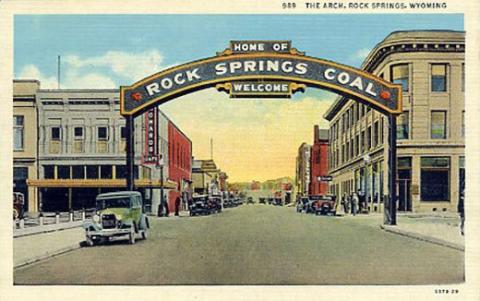
The Rock Springs, Wyoming economy seemed (and still seems) to be in a continual boom/bust cycle. The major careers in the area revolved and still revolve around resource extraction, also known as coal and trona mining. (Oil and natural gas extraction caused another boom starting in about 2000, after I was gone.)

The Blair brothers opened the first coal mine in Rock Springs in 1868 just before the arrival of the Union Pacific Railroad line. At one point Rock Springs and the surrounding Sweetwater County hosted 130 operating mines.

Coal mining fueled the railroads and the local economy, but took a hit in the 1890 depression. But mining rallied again in 1920, allowing men to make a larger wage of $8/ day in the mines bringing out coal. According to a Wyoming history essay $8 was the equivalent of $91/day in 2012. The Great Depression hit the area again, but due to neighbors helping neighbors, many weathered that storm and came out the other side.

Of course, Rock Springs was not always a neighborly place to live. For a rather small and desolate place, Rock Springs attracted all types of people. Robert Leroy Parker aka Butch Cassidy worked on several of the ranches that surround the town and he spent a brief time as a butcher in town, hence the nickname Butch. He left without causing problems in the little town.

Yet Butch was just a small note in the 1880 history of the town. The big news, that I was even taught in fourth grade, involved the Chinese Massacre. For a town that often seemed to embody cultural diversity, the Massacre was a huge black spot.

It happened on September 2, 1885. White miners attacked the Chinese miners who had been brought in by the railroad to help work the mines. When the conflict ended, twenty-eight Chinese were dead, fifteen were wounded, and hundreds more had fled the town. Most of the whites who caused the problem left soon after. And fortunately not all the Chinese fled, because Rock Springs boasted some of the best Chinese food anywhere thanks to their descendants a hundred years later.

In the 1950's when trains switched to diesel and cars took over the roads, the coal industry took a huge hit, but at that same time the largest known deposit of  trona was discovered. Out of work coal miners easily switched over to working in the trona mines east of Green River.

And again because of coal the Rock Springs economy boomed when in the 1970's, workers flooded into the area to build the billion dollar Jim Bridger Power Plant which still supplies coal fired power (electricity) to parts of the northwest, including the Idaho house where I currently live.

The climate was tough. The jobs were hard. And the people were rough.

Money flowed out of the mines. Much of it into the pockets of people who ran the railroad, but because coal was vital to the rail industry, large amounts also went back to the workers. Many of the people of Rock Springs came as immigrants from Europe and Asia to work in the mines. Many had money because they were miners. Others provided services to miners. Some services legal (food, housing, education). Some not so (prostitution and drugs).

The town was in a perpetual boom/bust cycle, and so were the people.

Like I said, the people were rough. But mostly they were good. Many believed in God. Many went to church. Rock Springs had many denominations: Catholic, Greek Orthodox, Episcopal, Christian Science, Seventh Day Adventist, Lutheran, Methodist, Presbyterian, Latter-day Saints, Baptists Free Evangelical, Congregational, and Jehovah Witness.

A history of the Catholic Church in Rock Springs 
written by one of my high school English teachers, 
Gloria Tomich can be found here.


Some went to church every Sunday. Some went for Christmas and Easter. Some just claimed a religion but never really went. Some didn't claim anything and ridiculed the those who did. And probably that is what made all of them who they were. Because, despite the ever popular belief that God doesn't matter, people have to have something to hold on to. They have to root themselves in some kind of bedrock. Center themselves firmly with faith in something. Otherwise the whims of the world and that continually blasting wind will blow you away.

It took me years to come to an understanding of what exactly helped me get through my teens, in that place, with some people who were quite good, some who were quite confused, and some who were just plain evil. (I say this with the authority of a girl who went to school with multiple murders. Some were just stupid kids who walked the halls of my high school during the days and partied in the hills on the weekend. Not all of them and the passengers in their trucks made it home. Another who I sat in front of in chemistry was just a messed up, drunk and abandoned kid. Then there was the one who had us all a bit terrified that one week in winter; he was bad news.)

So what was it that helped?

Let me tell you a childhood memory. I went to elementary school back in the olden days when they  actually had swing sets, slides, and merry go rounds on the playgrounds. And not only that they put them on black top. No spongy rubber or bark for us. I loved the swings, kind of liked the slides, but spent most of fourth grade on the merry go round. Ours was red.


We of course liked to hang onto the bars and lean back with our feet on the edge. Or better yet sit on the bar with a foot hooked around the standards near the edge and essentially do a back bend. If you were really good, your long hair could drag the ground. And yes the thing was spinning the whole time.

It wasn't safe. It was crazy. But we did it. (Okay my hair never touched the ground. That was TOOOO SCARY!)

Many years later I was thinking back on that experience and the tough times that were a part of growing up in Rock Springs schools and it occurred to me that when somebody stood in the center of the merry go round (not that we did it much), it was much less likely that they would go flying off into space, crashing disastrously on the black top. And if they sat down in the center and held on focusing on staying right there. They moved very little.

For me becoming centered on Christ and His standards was the thing that kept me from flying off into the arms of disaster. Did I want to be more popular? Yes. Was I willing to stand up let go of the standards and try and hold onto with my fingertips and toes on the edge like many of my friends seemed to be doing where the wind could grab you and batter you. No. I really wasn't.

And that saved me from pain. Sure I was kind of lonely some times. And sometimes I cried. Definitely I felt left out and odd, but all of those feelings ended when I left and went to college with people who could have fun without drinking, drugging, or giving up a part of themselves for someone's momentary pleasure.

Because I stayed pretty much stuck to the center, I had none of the habits and broken relationships to move past.

So looking back, am I glad I came from such a colorful and varied place? Yes. Am I grateful for all the people I knew there, many who were kind and good examples to me and some who were kind and rotten examples? Yes.

But mostly -- I am glad that I don't have that stupid wind to fight any more.

I am stronger because of where I came from. I am stronger because of all the people who taught me good and bad. I am stronger because I had to constantly battle against the wind both figuratively and literally. I am stronger because I clung to Christ. I cling still.


Sunday, March 29, 2015

The Compliment that Diminishes

One day I hung up the phone after an interesting conversation. The conversation opened with the other party commenting on how I was singing with one of the most accomplished voices in the valley in the near future. No mention of me being the one to organize this number, or it being my music, or the fact that I must have a least a bit of talent to sing a duet with someone of such stature. Not that I have to have strokes like that, but you know, a girl likes to hear that she is appreciated, especially when the complimentor is doing such a good job telling you how amazing someone else is.

The conversation continued with compliments about my family and how marvelous and appreciated my children's talents are. And finished with the lovely job that some one else did putting together a band for Valentine's Day. (A band that I sang lead for. BTW. Not a mention...)

While appreciation flowed through the conversation, I somehow  left it feeling manipulated and under appreciated. I wanted to believe that perhaps the complemenor told others how amazing I was, but I didn't have great faith in that. Mostly I felt the sting of being the other one singing with the accomplished musician.

And I wondered why I felt this way? I have, in fact struggled with these feelings for years. That conversation occurred a year ago this spring. But I have known people who could wield a compliment like a whip. A stinging, cracking thing that brought no joy.

As I thought it over it came to my mind that sometimes compliments increase the joy and confidence of the recipient and sometimes they diminish.

I remembered the talk by Elder Jeffrey Holland called The Tongue of Angels. He delivered it in April 2007 and at the time I recognized the truth in this statement.
"...try not to compare your children, even if you think you are skillful at it. You may say most positively that 'Susan is pretty and Sandra is bright,' but all Susan will remember is that she isn’t bright, and Sandra that she isn’t pretty. Praise each child individually for what that child is, and help him or her escape our culture’s obsession with comparing, competing, and never feeling we are 'enough.'"
Just the other day I spoke with a dear friend who said to me, "I think that I can name good the talents and good qualities of all of my siblings, but I am not sure that I can a name single thing that I do well."

I told her that she was intelligent and capable. A person with whom I loved to spend time talking about life. And she is incredibly strong, and resilient. Despite the struggle of her youth and the less than positive words she has often been subjected to, she was triumphing. She listened to the opinions of others, opinions both helpful and otherwise, weighed them, and then from them carved her own way to a career and family that is a beautiful joy to behold.

And she responded to that compliment in the best way possible by simply saying, "Thank you."

Because that is the other side of this issue. Awkward responses to compliments. Not only do some folks give backhanded or loaded compliments, often the receiver deflects or destroys the the compliment with, "I am really not that great." "It was nothing." Or occasionally, "Yes I am amazing."

The perfect answer is "thank you". And a smile. Really that is all. You don't have to elaborate. Say thank you. Smile. And then let the moment pass.

So here I am a year later. I have identified what I was feeling that day, why it reminded me of others times from my past, and what I should do - which is smile graciously and then go find someone who will give me a real compliment to erase the sting of the non-compliment.

To finish my story. I didn't sing with the most amazing voice in the valley on that Sunday exactly a year ago today. She had something come up. A trip to visit family or something. I called the person of diminishing compliments to let him know that there would be a change.

He was going to be out of town.

I said not to worry. I would take care of it.

So I asked my oldest and vocally talented son to sing with me. He graciously agreed. I found the perfect song for which  he, a bass, sang tenor. (Choir was a success as far as stretching his range and developing his falsetto voice.)

It was a perfect experience I will treasure always.

If you want to hear our song visit the link below
Precious Savior, Dear Redeemer arr by Melissa Miller
(We sang it in the same octave. I was singing the top part, he was singing the lower voice.The blend and sound was airy and yet strong in conviction.) 

When it was over, someone told me, "That was amazing."

And I said, "Thank you."

Monday, January 19, 2015

Surrendering Control = Peace


As the days go by I have noticed something. My kids are growing up. It is a good thing. A happy thing. Frankly it kind of excites me. Yes I miss the little chubby hands in mine and the snugly warm chunks of sleepy clean toddlers in fuzzy pajamas after a bath. I miss the delighted look after a light bulb clicks on and suddenly they are walking, talking, reading, biking... 

And sometimes I even miss the dependence. The complete need for me. Mostly I don't because it was exhausting, but as the parent of teenagers, I do get tired of being "stupid" and "out of touch". And I do feel that tiny bit of utter panic as they launch themselves into the world.

Yet I shouldn't. I shouldn't worry and I shouldn't feel a frantic need to run their lives. I know that. I know that deeply. Every time I feel that frantic need to jump into a situation and start damage control I remember.

con·trolkənˈtrōl/
noun
the power to influence or direct people's behavior or the course of events.

About this time two years ago in January 2013, my oldest child was struggling in a class, I was struggling as a parent. I wanted to help him. I wanted to take over and make this work, even do the work. I fretted over his ability to understand the material. Was the teacher any good? Was my child the problem? How would he get scholarships if he got a low grade in this subject? I worried that he was not going to survive this class and while I did my best to remember how to do that stuff, I was slightly put out that I was taking this class again twenty five years later. I got an A the first time. (Thanks Mr Varras!) Why did I have to do it again?

During this season I was praying for help. Praying to know what I could do to assist this child. I remember distinctly the impression that came. It was a clear impression to be still and let this child swim or flounder and/or sink on his own. I saw that this was his life and his problem. If he didn't get a scholarship that was not my worry. I had done all I could do when I was in high school to qualify for a scholarship. If this child didn't he would have to figure out another way on his own. 

This child needed to figure it out himself. And he did. In ways that astonished me. His grade still wasn't what I wanted, but he received a scholarship for part of college anyway. Then he went and learned about other funding options on his own and in a way that impressed me with his thoughtfulness and planning.

I grew and matured greatly due to that experience. 

I had always believed that I had a responsibility for my children's education, and I do. I need to teach them to be responsible. I need to make sure they get the skills and knowledge they need to be successful in life. I need to teach them about God and His plan for us. And I need to make sure that they can work both physically and mentally. I don't need to sit in their classes and keep track of their assignments. I never need to do work for them, but I do keep tabs on their grades and remind/advise/nag when needed. 

So far somewhere around the time they turn sixteen, I find it becomes important for them to take over nearly complete control of their choices with school and life. Not that I've opened all the boundaries and made our home and their lives in it a rule free zone. Nor have I stopped checking grades and being a sounding board for them, but I have to trust that I have taught them enough and not follow behind them out in the world like I did when they were learning to ride a bike and cross the street.

President Boyd K Packer of the Twelve Apostles related this story about control and children,

"Several weeks ago I had in my office a four-star general and his wife; they were very impressive people. They admire the Church because of the conduct of our youth. The general’s wife mentioned her children, of whom she is justly proud. But she expressed a deep concern. 'Tell me,' she said, 'how you are able to control your youth and build such character as we have seen in your young men?'
I was interested in her use of the word ‘control’. The answer, I told them, centered in the doctrines of the gospel. They were interested; so I spoke briefly of the doctrine of agency. I said we develop control by teaching freedom. Perhaps at first they thought we start at the wrong end of the subject. A four-star general is nothing if not a disciplinarian. But when one understands the gospel, it becomes very clear that the best control is self-control.
It may seem unusual at first to foster self-control by centering on freedom of choice, but it is a very sound doctrinal approach."
He goes on to explain, 

"The temptation your children will face will not come at home nor in the seminary class. It will come later, when they are away from both teacher and parent. One day you must set them free. When that day comes, how free will they be, and how safe? It will depend on how much truth they have received."

So last Thursday as I watched a mom of another teenage boy struggle over choir tour we are involved in planning, I reflected back on what I learned and how it is working out for me to live by that inspiration. I must say I am feeling peace. 

She wants to control all aspects of the trip so that no one will make a poor choice. She is worried that they won't have an educational experience. She thinks that if she is vigilante enough and has enough rules and enough service, educational, and competition filled activities planned for every second, she will stop the kids who want to find drugs and alcohol and sex on this trip.

I have my doubts, but wish her luck. She has an uphill battle against 128 kids, their ideas, their parents' ideas. And frankly the reality that you can't control much beyond your own  thoughts, appetites, speech, temper, and desires. 

Some, even many, of those kids are going to go and have a lovely trip choosing to exercise self control. A few will choose to try and do something stupid. A repeat of pretty much every high school trip ever taken.

Life is full of choices. And we all get to make them. Sometimes they are good. Sometimes our choices are not good. Sometimes they affect us and others and bring on the storms of life. Paulo Coelo, the author of the book The Alchemist said,
"I have seen many storms in my life. Most storms have caught me by surprise, so I had to learn very quickly to look further and understand that I am not capable of controlling the weather, to exercise the art of patience and to respect the fury of nature." 
I like to think that most storms in nature and life don't catch me by surprise, but some do. Some are truly furious, but they don't have to crush us. We don't have to fight them. We don't have to control them. We usually can't do either. But we can be patient. We can keep our head down and endure through them. Sometimes we can even take shelter in a doorway and find the beauty in them as they go by.

Back to my story.

A little over a year after the experience with the high school class, I watched that child turn eighteen, graduate from high school and then head three months later to a country where crime is rampant. He is serving the Lord there. Many would say not to worry, he will be fine. He is in the Lord's hands. And he is, but that is no guarantee that he will be safe. Missionaries have been kidnapped there. Raped. Killed by accidents. Not murdered yet, but lots of other people are murdered, daily, it isn't out of the question.

I truly have no control of any part of this situation.

A mother from church whose oldest son is the age of my youngest son asked me, "How do you do it? How do you let them go to such a scary place?"

The answer is two fold and has to do with the things that I can control. One - I have taught him self control and personal responsibility and thanks to the urging of the Holy Spirit; I watched him demonstrate those skills while he still lived under my roof. Two - I have faith that he is doing what he is supposed to be doing right now in his life. I have faith that he has been sent through inspiration to teach the struggling people of Guatemala about the plan of salvation and our Savior. 

I expect that he will return safely, but if not (Daniel 3:17-18), it is okay.

A great article about how to achieve this state of peace is found here.